
Wolves living near Chernobyl seem to fight cancer
Listen to the story (British accent)
In 1986, a nuclear reactor exploded at the Chernobyl power plant in Ukraine. It released deadly radiation and over 100,000 people had to leave the city.
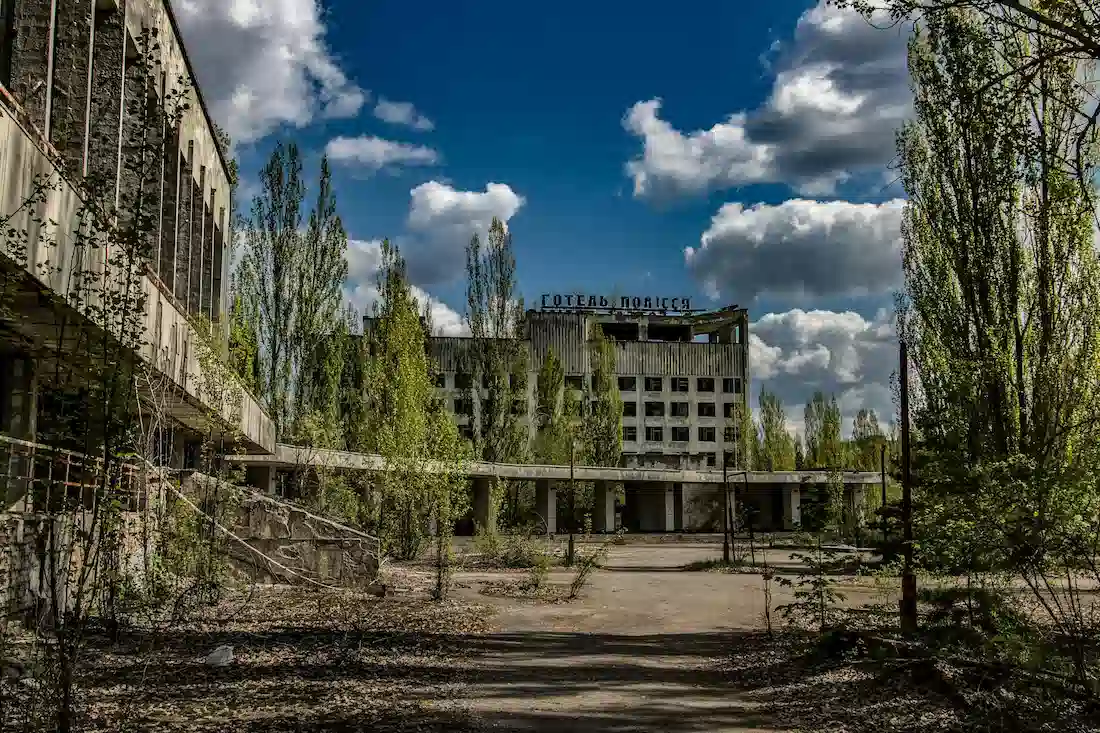
The area around the power plant is still dangerous and people are not allowed to go there. It’s called the Chernobyl Exclusion Zone (CEZ).
Although everyone left, animals like wolves and horses still live there. Dr. Cara Love, a scientist from Princeton University, has been studying these wolves.
In 2014, Dr. Love and her team went to the CEZ. They put special radio collars on the wolves to track where they go and how much radiation they are exposed to. They also checked the wolves’ blood to see how it reacts to the radiation.
The wolves are exposed to a lot of radiation every day, more than six times the safe limit for humans. But they seem to be okay. Their immune systems have changed in a way that’s similar to humans who get treatment for cancer. Dr. Love also found that the wolves’ genes have changed to protect them from cancer.
This could help scientists understand how to protect humans from cancer. For example, some humans have a gene that makes them more likely to get breast or ovarian cancer. But Dr. Love’s work is trying to find genes that can help people survive cancer.
Because of COVID-19 and the war in Ukraine, Dr. Love and her team haven’t been able to go back to the CEZ. They hope to return when it’s safe.
Vocabulary21 words
- Nuclear reactor
- a facility that generates/makes heat and electricity through the use of nuclear reactions; ⚛️☢️
- Explode
- To burst suddenly with a lot of force; ?
- Power plant
- A place where electricity is made; A big building that makes electricity ⚡
- Release
- To let go or set free; to let out into the world; to let something out
- Radiation
- Harmful energy released in the form of particles or electromagnetic waves ☢️
- Scientist
- a person who studies science or the natural world; researcher; ?????
- Radio collar
- a device that is attached to an animal and sends out signals that can be tracked by radio
- Track
- to follow and record; to note or study progress; to follow
- Expose
- to put someone at risk from something harmful or unpleasant; To put something where it can be seen or touched
- React
- to respond or show a response to something that happens; to act in a particular way as a direct result of something else
- Times
- A way of saying how many times one number is multiplied by another; ‘X’; How many of something there are
- Limit
- a boundary or restriction; the maximum allowed;
- Human
- a person; a man, woman or child
- Immune system
- The part of your body that fights off germs; The body's defense against sickness
- Treatment
- medical care; surgery; the process of fixing an injury or illness
- Cancer
- a disease in which some of the body's cells grow uncontrollably and spread to other parts of the body
- Find
- realize; learn; discover;
- Gene
- a small part of DNA that contains information that determines traits, such as eye color or height
- Protect
- keep safe or secure; guard; defend
- Likely
- high chance; surely; high certainty; more than 70%
- Survive
- To stay alive or keep going even if the situation/circumstance is difficult or dangerous
📚 Ready to use these words in a real conversation?
Practice live with a real tutor on Preply.

✅ Nice work on the quiz!
Keep the momentum going — book a live English lesson with a Preply tutor.
Fill-in-the-blank listening
Play the audio again and fill in the missing words as you listen.
In _____, a nuclear reactor exploded at the Chernobyl _____ plant in Ukraine. It released deadly radiation and over _____ people had to leave the city.
The _____ around the power plant is still dangerous and people are not _____ to go there. It’s called the Chernobyl Exclusion _____ (CEZ).
Although everyone left, _____ like wolves and horses still live there. Dr. Cara Love, a _____ from Princeton University, has been studying these wolves.
In _____, Dr. Love and her team went to the CEZ. They put _____ radio collars on the wolves to track where they go and how much _____ they are exposed to. They also checked the wolves’ blood to see _____ it reacts to the radiation.
The _____ are exposed to a lot of radiation every day, more than six times the safe limit for _____. But they seem to be okay. Their immune _____ have changed in a way that’s similar to humans who get treatment for _____. Dr. Love also found that the wolves’ genes have _____ to protect them from cancer.
This could help scientists _____ how to protect humans from cancer. For example, some humans have a _____ that makes them more likely to get breast or ovarian cancer. _____ Dr. Love’s work is trying to find genes that can help people _____ cancer.
Because of COVID-19 and the _____ in Ukraine, Dr. Love and her team haven’t been able to go _____ to the CEZ. They hope to return when it’s _____.
Discussion questions
- Why do you think it’s important to study how animals react to environments like the CEZ?
- How do you think Dr. Love’s research could help humans?
- What are some challenges you think Dr. Love and her team might face when they return to the CEZ?
- How do you think the lives of the wolves in the Chernobyl Exclusion Zone are different from those in more natural environments?
Common questions
Do the wolves at Chernobyl really resist cancer?
Research led by Dr. Cara Love of Princeton University found that wolves living inside the Chernobyl Exclusion Zone appear to have developed changes in their immune systems, similar to what is seen in cancer patients receiving radiation treatment, suggesting some resilience to the radiation they are exposed to every day.
How much radiation are the Chernobyl wolves exposed to?
The wolves live inside the Chernobyl Exclusion Zone, the restricted area around the power plant that exploded in 1986. Scientists fitted them with radio collars to track their movements and measure their radiation exposure in the zone, which remains too dangerous for people to live in.
Do people live in the Chernobyl Exclusion Zone?
No. More than 100,000 people had to leave after the 1986 accident and the area is still closed to residents. Wildlife such as wolves and horses now lives there largely undisturbed.
🎓 Enjoyed this story?
Turn today's reading into real speaking practice with a live Preply tutor.

More Nature stories
Next story · Medium
Nuclear fusion record, closer to unlimited clean energy