
Wolves living near Chernobyl seem to fight cancer
Listen to the story (British accent)
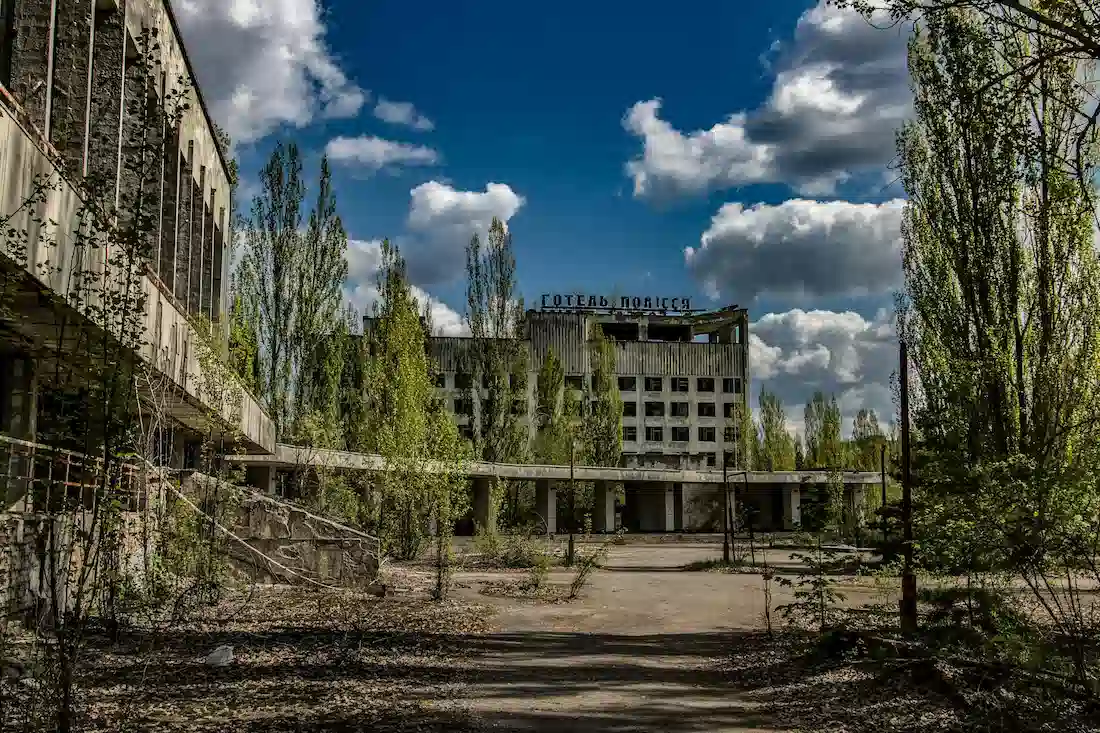
In 1986, the Chernobyl nuclear power plant exploded. It was very dangerous and 100,000 people had to leave the city.
Now, it’s still dangerous and people can’t go near the power plant. This place is called the Chernobyl Exclusion Zone (CEZ).
There are no people, but animals like wolves and horses live there. A scientist named Dr. Love studies these wolves.
In 2014, Dr. Love and her team went to the CEZ. They put special collars on the wolves to see where they go and how much dangerous radiation they get. They also checked the wolves’ blood.
The wolves get a lot of radiation every day, but they seem to be okay. Their bodies have changed to fight cancer. Dr. Love is learning how their bodies changed. This could help scientists protect people from cancer.
Because of COVID-19 and the war in Ukraine, Dr. Love and her team can’t go back to the CEZ. They hope to go back when it’s safe.
Vocabulary13 words
- Nuclear power plant
- a facility that generates/makes heat and electricity through the use of nuclear reactions; ⚛️☢️
- Power plant
- A place where electricity is made; A big building that makes electricity ⚡
- Explode
- To burst suddenly with a lot of force; ?
- Dangerous
- Not safe; can cause harm; can hurt
- Scientist
- a person who studies science or the natural world; researcher; ?????
- Study
- to learn more; to research;
- Collar
- A band that goes around the neck, like for a dog or cat
- Radiation
- Harmful energy released in the form of particles or electromagnetic waves ☢️
- Check
- to carefully look at; To examine or inspect something closely; to confirm; investigate
- Blood
- ?; The fluid that moves through the body and carries oxygen and nutrients to cells and organs
- Fight
- to use a lot of effort to defeat/stop something, achieve something, or to stop something happening
- Cancer
- a disease in which some of the body's cells grow uncontrollably and spread to other parts of the body
- Protect
- keep safe or secure; guard; defend
📚 Ready to use these words in a real conversation?
Practice live with a real tutor on Preply.
✅ Nice work on the quiz!
Keep the momentum going — book a live English lesson with a Preply tutor.

Fill-in-the-blank listening
Play the audio again and fill in the missing words as you listen.
In _____, the Chernobyl nuclear power plant exploded. It was very _____ and 100,000 people had to leave the city.
_____, it’s still dangerous and people can’t go near the power _____. This place is called the Chernobyl Exclusion _____ (CEZ).
There are no people, but _____ like wolves and horses live there. A scientist named Dr. Love _____ these wolves.
In 2014, Dr. Love and her _____ went to the CEZ. They put special collars on the wolves to see _____ they go and how much dangerous radiation they _____. They also checked the wolves’ _____.
The wolves get a lot of _____ every day, but they seem to be okay. Their bodies have changed to _____ cancer. Dr. Love is learning how their _____ changed. This could help scientists protect people from cancer.
_____ of COVID-19 and the war in Ukraine, Dr. Love and her team can’t go _____ to the CEZ. They hope to go back when it’s _____.
Discussion questions
- Why do you think it’s important to study how animals live in places like the CEZ?
- Do you think learning about how the wolves fight cancer could help people too? Why or why not?
- Why do you think the Chernobyl Exclusion Zone (CEZ) is still dangerous even after many years of the nuclear explosion?
- Do you think the lives of the wolves in the Chernobyl Exclusion Zone are different from those in more natural places?
Common questions
Do the wolves at Chernobyl really resist cancer?
Research led by Dr. Cara Love of Princeton University found that wolves living inside the Chernobyl Exclusion Zone appear to have developed changes in their immune systems, similar to what is seen in cancer patients receiving radiation treatment, suggesting some resilience to the radiation they are exposed to every day.
How much radiation are the Chernobyl wolves exposed to?
The wolves live inside the Chernobyl Exclusion Zone, the restricted area around the power plant that exploded in 1986. Scientists fitted them with radio collars to track their movements and measure their radiation exposure in the zone, which remains too dangerous for people to live in.
Do people live in the Chernobyl Exclusion Zone?
No. More than 100,000 people had to leave after the 1986 accident and the area is still closed to residents. Wildlife such as wolves and horses now lives there largely undisturbed.
🎓 Enjoyed this story?
Turn today's reading into real speaking practice with a live Preply tutor.

More Nature stories
Next story · Easy
Nuclear fusion record, closer to unlimited clean energy