
Tsunami warnings after powerful earthquake
Listen to the story (American accent)
A very powerful earthquake with a magnitude of 8.8 happened in the ocean near the Kamchatka Peninsula in Russia on Wednesday.
The earthquake was shallow and close to the Earth's surface. Officials issued tsunami warnings for many countries around the Pacific Ocean, including Japan and the United States.
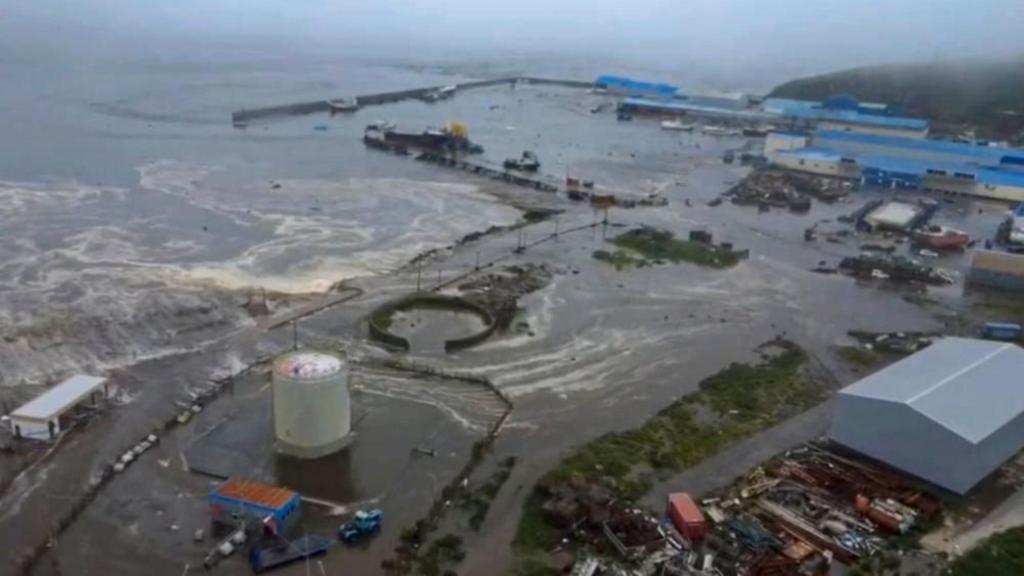
In Russia, the earthquake was the strongest in the region since 1952. Tsunami waves up to four meters high hit the coast of Kamchatka. A few people were injured, but officials said the injuries were not serious. A local kindergarten building was also damaged by the shaking.
In Japan, the government ordered a large evacuation. More than 900,000 people living along the country’s east coast were told to move to higher ground. This is the same area that was badly damaged by a large tsunami in 2011.
The government warned that the second and third tsunami waves can sometimes be bigger than the first. Workers at the Fukushima nuclear power plant were evacuated for safety, but no problems were reported.
The United States also issued tsunami warnings for coastal areas in Alaska, Hawaii, California, and Oregon. The US Tsunami Warning Center said waves could be up to three meters in some places.
Japanese officials expected waves up to 3 meters high along their coast. However, so far, only smaller waves of about 30 cm have been seen. Japan is located on the "Pacific Ring of Fire," an area where many earthquakes happen, so it is well-prepared for these emergencies.
Vocabulary30 words
- Powerful
- Very strong
- Earthquake
- a natural event where the ground shakes and moves suddenly and strongly, caused by the movement of rocks deep beneath the earth's surface
- Magnitude
- The size or strength of something, especially an earthquake; the measure of an earthquake’s strength/size
- Pacific Ocean
- the largest ocean on Earth, located between Asia and North and South America
- Shallow
- Not deep; opposite of deep or far down
- Earth
- the planet/world we live on 🌎
- Surface
- the top or outside layer of something; exterior; ground
- Official
- a person who works for the government or a government company and has power or authority; officer; executive
- Issue
- announce; to tell everyone; to formally send out or share
- Tsunami
- a large, powerful wave in the sea caused by an earthquake or volcano that can destroy many things; 🌊
- Warning
- a message that alerts/informs people about a dangerous situation or a possible threat
- Including
- together with; as well as; part of a group or many; plus
- Region
- a large area of the Earth; an area of land with similar qualities/characteristics
- Wave
- A moving line of water in the ocean; 🌊
- Up to
- as high as; as many as; maximum
- Coast
- the land along the edge of the sea or an ocean; where land meets water
- Injured
- hurt; wounded; harmed; to have damage to your bodyInjured -
- Local
- related to or connected to a specific/particular place; existing in or belonging to the area that you are talking about; part of or in the city or country you’re talking about
- Shake
- To move quickly back and forth
- Government
- the group of people who have the authority to make and enforce laws and manage a country or region; the people/group that manage and operate a country
- Order
- To tell someone to do something
- Evacuation
- Moving people away from a dangerous place
- Ground
- floor; earth; solid surface; dirt
- Warn
- to tell someone about something bad or dangerous that might happen; alert; notify
- Nuclear power plant
- a facility that generates/makes heat and electricity through the use of nuclear reactions; ⚛️☢️
- Report
- to tell other people about something; to share information; announce; explain
- Area
- A place or part of a place; piece of land, or country; a particular part of a place; somewhere
- Expect
- to think something will happen; forecast; predict; suppose
- Located
- to be in a particular place; to be found in a specific spot; to be ‘there’;
- Well-prepared
- Ready for something
📚 Ready to use these words in a real conversation?
Practice live with a real tutor on Preply.

Quiz
Answer key
1. Near Russia 2. Move to higher ground 3. True
✅ Nice work on the quiz!
Keep the momentum going — book a live English lesson with a Preply tutor.

Fill-in-the-blank listening
Play the audio again and fill in the missing words as you listen.
A very _____ earthquake with a magnitude of 8.8 happened in the _____ near the Kamchatka Peninsula in Russia on _____ .
The earthquake was _____ and close to the Earth's surface. Officials _____ tsunami warnings for many countries around _____ Pacific Ocean, including Japan and the United States.
In _____ , the earthquake was the strongest in the region since _____ . Tsunami waves up to four meters high hit the _____ of Kamchatka. A few people were injured, but _____ said the injuries were not serious. A local kindergarten _____ was also damaged by the shaking.
In _____ , the government ordered a large evacuation. _____ than 900,000 people living along the country’s east coast _____ told to move to higher ground. This is the _____ area that was badly damaged by a large tsunami in _____ .
The government warned _____ the second and third tsunami waves can sometimes be _____ than the first. Workers at the Fukushima nuclear _____ plant were evacuated for safety, but no problems were _____ .
The United States _____ issued tsunami warnings for coastal _____ in Alaska, Hawaii, California, and Oregon. The US Tsunami Warning Center _____ waves could be up to three meters in some places.
Japanese officials _____ waves up to 3 meters high along their _____ . However, so far, only smaller waves of about _____ cm have been seen. Japan is located on the "Pacific Ring of Fire," an area where _____ earthquakes happen, so it is well-prepared for these _____ .
Discussion questions
- What are some of the actions people should take when they hear a tsunami warning?
- The article talks about evacuations. What do you think are the biggest challenges for people who have to evacuate their homes?
- The article says Japan is "well-prepared" for emergencies. What does this mean to you, and what are some things a country can do to be ready for an earthquake or tsunami?
- Do you think people should move away from coastal areas if they know that earthquakes and tsunamis are common? Why or why not?
🎓 Enjoyed this story?
Turn today's reading into real speaking practice with a live Preply tutor.

More Nature stories
Next story · Medium
UK wants to lower voting age to 16