
Humanoid robot in China could help old people
Listen to the story (Hong Kong accent)
The number of people in China who are 60 years old or older is expected to increase from 280 million to over 400 million by the year 2035.
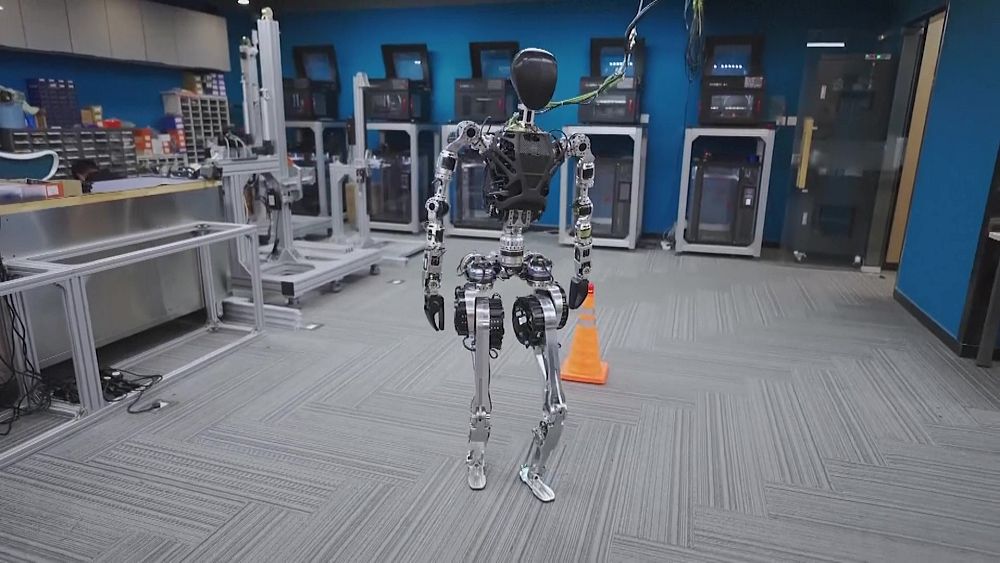
Because of the aging population there will not be enough healthcare workers. To help solve that problem, a company called Fourier Intelligence in Shanghai is creating a special kind of robot that can be used in healthcare facilities.
The robot, called GR-1, is designed to help take care of elderly people who live alone. It is about 1.64 meters tall and weighs 55 kilograms. GR-1 can walk, avoid obstacles, and perform simple tasks like holding bottles.
The CEO of Fourier Intelligence, Zen Koh, says that GR-1 could be used as a caregiver, a therapy assistant, or a companion for the elderly.
Although GR-1 is still in the research and development phase, the goal is to have a working prototype ready within the next two to three years. When it’s ready, GR-1 will be able to assist patients by helping them move from their beds to wheelchairs and by picking up objects for them.
Fourier Intelligence has already developed other tools for rehabilitation and exoskeletons, which help support patients' arms and legs during physical therapy.
GR-1, a humanoid robot, was introduced at the World AI Conference in Shanghai with Optimus, a prototype from Tesla, and X20, a four-legged robot. DEEP Robotics will develop the X20 for emergency rescue and fire detection.
Vocabulary29 words
- Expect
- to think something will happen; forecast; predict; suppose
- Age
- to grow old; to make/cause someone to look older
- Population
- all the people living in a particular country, area, or place
- Healthcare
- the services and treatments related to keeping people healthy, preventing and treating illnesses, and providing medical care
- Solve
- to find an answer; to find an explanation; to create a way to fix a problem; answer; work out
- Facility
- a place, building, or equipment used for a particular purpose or activity; depot; plant; center
- Elderly
- Older people; people who are old
- Avoid
- stay away from; keep away; try not to do
- Obstacle
- Something that gets in the way or makes it difficult to do something
- Perform
- to do; achieve; to carry out; conduct; function; run
- Task
- A specific job or assignment; chore; work
- CEO (Chief Executive officer)
- the top person in a large company; president; boss
- Caregiver
- Someone who takes care of another person, usually in terms of their health
- Therapy
- Treatment or activities to help someone feel better, especially for their physical or mental health
- Companion
- A friend or someone who spends time with another person
- Although
- even though; despite the fact; however; but
- Research and development (R&D)
- activities/processes that companies do to innovate/create new products and services; A process of learning and creating new things
- Phase
- A specific stage or step in a process; a part of a process or project
- Goal
- aim or purpose; objective; target; something you want to achieve or complete
- Prototype
- example; the first version; the original which will be copied later;
- Within
- in a certain amount of time
- Once
- at a specific moment; when
- Assist
- To help or support someone
- Patient
- Someone who receives medical treatment or care;
- Object
- A thing that you can see or touch; thing
- Rehabilitation
- the process of helping someone recover from an injury or illness
- Exoskeleton
- A wearable device that supports and protects a person's body; a hard structure that supports the body Humanoid - Something that looks like a human or has human characteristics
- Introduce
- To make something or someone known to others for the first time; to show; to present
- Detection
- Finding or discovering something, usually with the help of technology or tools
📚 Ready to use these words in a real conversation?
Practice live with a real tutor on Preply.

✅ Nice work on the quiz!
Keep the momentum going — book a live English lesson with a Preply tutor.

Fill-in-the-blank listening
Play the audio again and fill in the missing words as you listen.
The number of _____ in China who are 60 years old or older is expected to increase from 280 million to over 400 million by the year 2035.
Because of the _____ population there will not be enough healthcare _____. To help solve that problem, a company called Fourier Intelligence in Shanghai is _____ a special kind of robot that can be used in healthcare facilities.
The robot, called GR-1, is _____to help take care of elderly people who live alone. It is about 1.64 meters tall and _____ 55 kilograms. GR-1 can walk, avoid obstacles, and perform simple tasks like holding bottles.
The _____ of Fourier Intelligence, Zen Koh, says that GR-1 could be used as a caregiver, a therapy assistant, or a companion for the _____.
Although GR-1 is still in the research and _____ phase, the goal is to have a working prototype ready within the next two to three years. When it’s ready, GR-1 will be able to assist _____ by helping them move from their beds to wheelchairs and by picking up _____ for them.
Fourier Intelligence has already developed other tools for rehabilitation and exoskeletons, which help support patients' arms and legs _____ physical therapy.
GR-1, a humanoid robot, was introduced at the World AI Conference in _____with Optimus, a prototype from Tesla, and X20, a four-legged robot. DEEP Robotics will develop the X20 for emergency _____ and fire detection.
Discussion questions
- Do you think robots can replace human caregivers in the future? Why or why not?
- Would you feel comfortable having a robot like GR-1 as a companion for yourself or your loved ones? Why or why not?
- What are some of the challenges that might be faced in using a robot like the GR-1 to help care for the elderly?
🎓 Enjoyed this story?
Turn today's reading into real speaking practice with a live Preply tutor.

More Technology stories
Next story · Medium
Burger King’s new burger is all cheese and no meat in Thailand