
Companies don’t like self-checkout anymore
Listen to the story (Canadian accent)
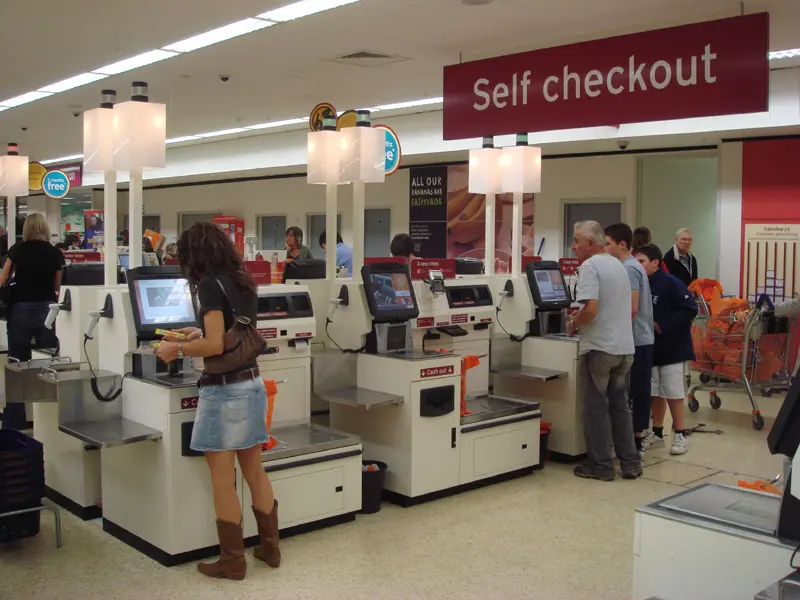
Many stores introduced self-checkout to make shopping faster. The stores also thought it would save money because the self-checkout area doesn’t need employees. However, the strategy is not working like they wanted.
Companies hoped people would like using self-checkout and bagging their items. But, many people still need help or make mistakes. Stores still need employees to fix problems and help customers with self-checkout.
Companies spent a lot of money, sometimes billions of dollars, to install self-checkout machines. Customers first started to see self-checkout machines in the 1990s. But now, some stores are changing their strategies.
For example, the shop Target in the US has a new rule. Customers can only use self-checkout if they have a few items to buy. Walmart removed some machines to stop stealing. In the UK, Booths removed some machines because customers said they were slow.
Dollar General, a store that is quickly growing popular in the US, has also changed its strategy. The company put a lot of self-checkout machines in their stores in 2022. Now, they plan to hire more employees for the check-out area.
Some stores worry about people stealing when using self-checkout. Data shows that stores using self-checkout have more stolen items than usual, double the average.
Self-checkout doesn't save as much money as stores hoped. However, some companies will keep self-checkout for a while because they spent so much money on it.
A 2021 survey asked shoppers what they prefer. 60% liked self-checkout, but 67% had problems using it.
Vocabulary21 words
- Introduce
- to start using for the first time; launch
- Self-checkout
- A machine where you scan and pay for your own items without shop staff
- Employee
- a person who is paid to work for a company or organization
- Strategy
- A plan or method to achieve a goal
- Hope
- something good that you want to happen in the future; a confident feeling about what will happen in the future
- Bag
- To put something in a bag
- Item
- a single object or thing; one piece; a product
- Billion
- 1,000,000,000 = one-billion
- Install
- to put something in place so that it is ready to use; to set up for use or service
- Rule
- A guideline or regulation; sometimes a law
- Remove
- to take out; to take away from; take off; to stop; to eliminate
- Steal
- to take something without permission; to take something that’s not yours; rob
- Grow
- To become bigger or increase in size; become
- Popular
- Liked by many people; something many people like
- Hire
- to pay someone to do a job; to employ; to give someone a job; to take a person into a company
- Area
- A place or part of a place; piece of land, or country; a particular part of a place; somewhere
- Data
- Information or facts that are collected and stored/kept
- Show
- to prove something or make the truth or existence of something known; confirm; demonstrate; to display; to represent
- Double
- two times more; 2x; 100% more
- Average
- a standard or level that is considered to be typical or usual; the usual or ordinary amount; normal level/amount
- Survey
- a poll or questionnaire; a set of questions for the public to understand opinion
📚 Ready to use these words in a real conversation?
Practice live with a real tutor on Preply.

✅ Nice work on the quiz!
Keep the momentum going — book a live English lesson with a Preply tutor.

Fill-in-the-blank listening
Play the audio again and fill in the missing words as you listen.
Many stores _____ self-checkout to make shopping faster. The stores also thought it would save _____ because the self-checkout _____ doesn’t need employees. However, the strategy is not working like they _____.
Companies hoped people _____ like using self-checkout and bagging their items. But, many _____ still need help or make mistakes. Stores still _____ employees to fix problems and help customers with self-checkout.
_____ spent a lot of money, sometimes billions of dollars, to _____ self-checkout machines. Customers first started to see self-checkout _____ in the 1990s. But now, some stores are changing their strategies.
_____ example, the shop Target in the US has a new rule. Customers can _____ use self-checkout if they have a few items to _____. Walmart removed some machines to stop _____. In the UK, Booths removed some machines because customers said _____ were slow.
Dollar General, a store that is quickly _____ popular in the US, has also changed its strategy. The company put a lot of self-checkout machines in _____ stores in 2022. Now, they plan to hire more employees for the check-out _____.
Some stores worry about people stealing when _____ self-checkout. Data shows that stores using self-checkout have more stolen _____ than usual, double the average.
Self-checkout doesn't _____ as much money as stores hoped. However, some companies will _____ self-checkout for a while because they spent so _____ money on it.
A 2021 survey asked _____ what they prefer. 60% liked self-checkout, but 67% had problems using _____.
Discussion questions
- What are the reasons stores introduced self-checkout, according to the text?
- Why do you think some customers prefer self-checkout while others don’t? What do you think about it?
- Why do you think some people still need help or make mistakes with self-checkout?
- What are some potential solutions to the problems faced by stores with self-checkout?
🎓 Enjoyed this story?
Turn today's reading into real speaking practice with a live Preply tutor.
More Business stories
Next story · Medium
China suggests large Gaza peace conference